
In semiconductor and display manufacturing, step coverage determines whether an ALD film actually works inside a trench, via, or capacitor hole. When ALD deposits into a deep feature, the bottom thins first — because each half-cycle must independently saturate from top to bottom, and the one that runs short sets the coverage at the bottom. Understanding where that limit comes from is the starting point for fixing it.
What Step Coverage Measures
Step coverage is the film thickness at a point inside a feature divided by the thickness on the top surface, expressed as a percentage. Most groups report bottom thickness over top thickness; others report a sidewall-to-top ratio. These numbers are not interchangeable — a step coverage value is only meaningful when you know which ratio was used and at what aspect ratio.
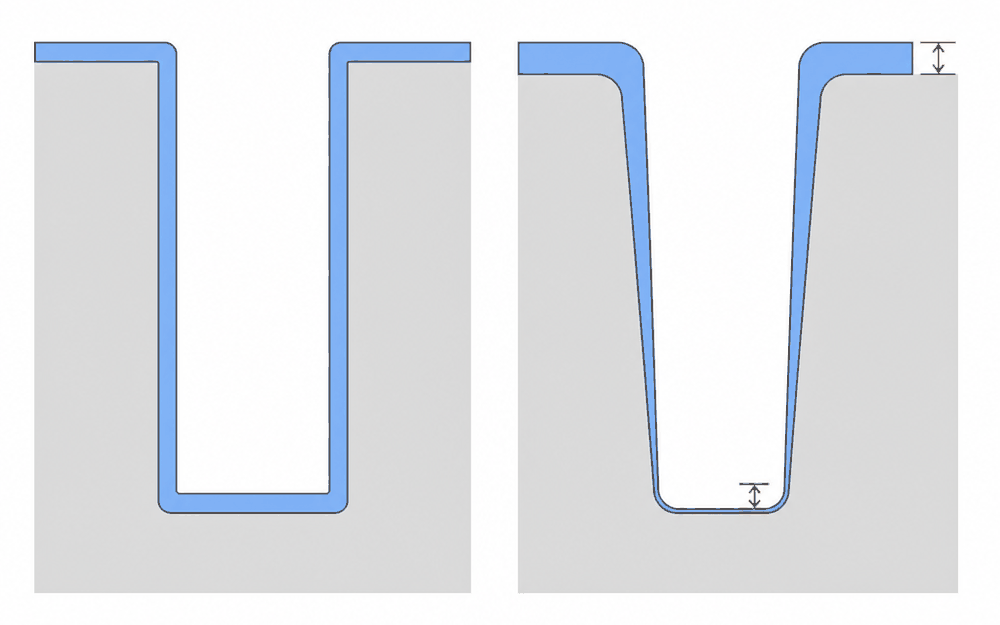
"Conformality" often appears as a synonym. Some engineers reserve it for how uniform the film is along the entire sidewall, not just a single-point ratio. Either way, the critical question is the same: is the film thick enough at the thinnest point to do its job?
Why ALD Step Coverage Falls From the Bottom Up
ALD is self-limiting. Each half-cycle — precursor pulse then purge, co-reactant pulse then purge — saturates the surface before the next begins. In an open, shallow feature both half-cycles reach every surface easily and the film grows evenly.
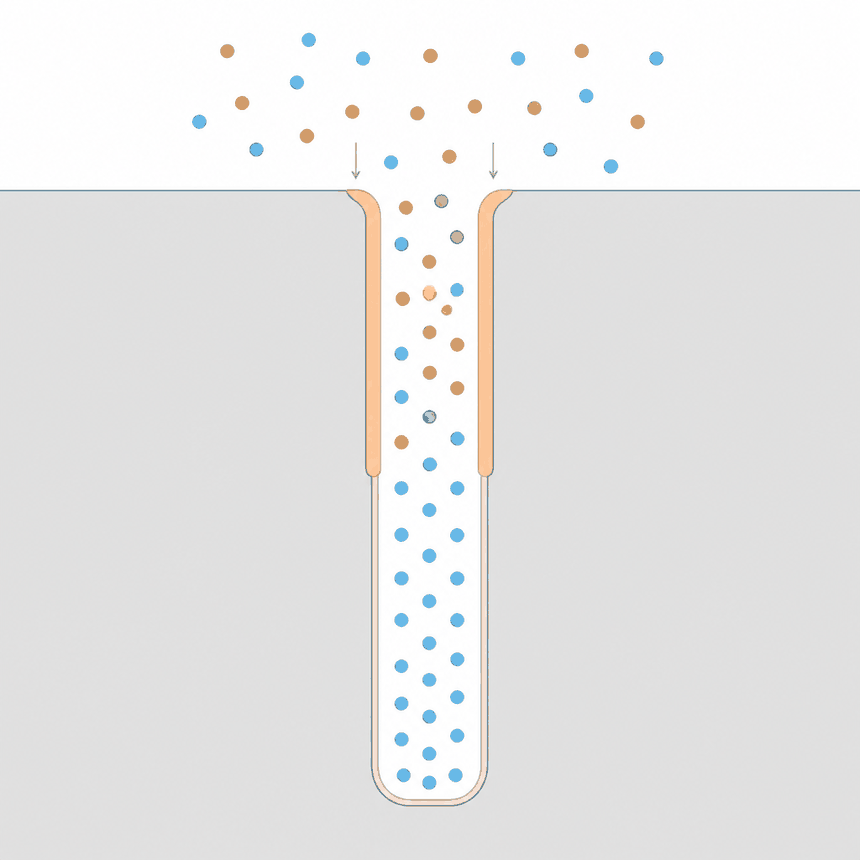
Inside a deep, narrow feature, reactant molecules reach the bottom only by bouncing off walls. The exposure needed to saturate the bottom rises steeply with aspect ratio. If the dose is insufficient, the upper portion saturates while the lower portion does not — coverage falls from the bottom up.
Growth at any depth requires both half-cycles. The local film thickness is set by the lesser of the two saturations at that depth. One half-cycle may penetrate easily while the other falls short; the short one becomes the bottleneck.
Thermal ALD vs. PEALD
In thermal ALD, co-reactants like water have a low sticking probability per wall bounce. They travel deep into features before reacting, which helps them reach the bottom of high-aspect-ratio structures.
Plasma-enhanced ALD replaces the thermal co-reactant with plasma-generated radicals. These radicals lose reactivity when they hit a surface — surface recombination removes them before they can travel far. Extending the plasma exposure helps less than expected, because fresh radicals still recombine on the upper walls. Thermal ALD therefore generally reaches deeper than PEALD in high-aspect-ratio features.
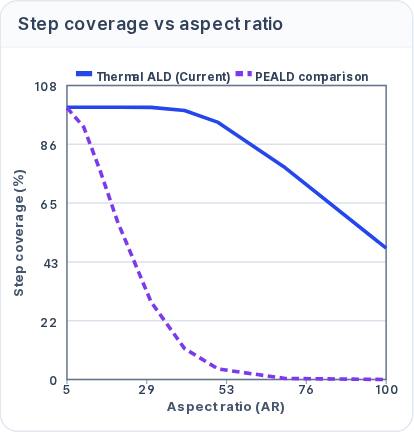
This does not make PEALD inferior across the board. For moderate aspect ratios or where a plasma-activated surface reaction is needed for film quality, PEALD works well. The choice depends on the structure.
What to Adjust First
Start with the half-cycle that limits coverage. Identify whether the precursor or the co-reactant is running short at the bottom, then increase its pulse time or partial pressure to raise the dose.
Purge matters too. If the purge between half-cycles is too short, the two reactants meet in the gas phase near the feature opening. That produces CVD-like growth — a thicker lip or overhang at the top that narrows the entrance and makes the problem worse.
For high-aspect-ratio structures, consider a thermal co-reactant instead of a plasma one where the film chemistry allows it. When radical recombination is the bottleneck, adding plasma time may not close the gap.
Checking Step Coverage in ALD Before You Run Wafers
Semi Process Lab lets you predict step coverage across aspect ratios and opening widths before committing to a process run. The process design screen shows a feature-scale deposition profile — film thickness versus depth, step coverage versus aspect ratio, and a stable process region map — all updated in real time as you adjust sliders for aspect ratio and opening width. Every value on the screen is a model prediction, not a wafer measurement.
The model computes each half-cycle's penetration separately and grows the film at each depth by the growth-per-cycle multiplied by the smaller of the two half-cycle coverages — the same bottleneck principle described above.
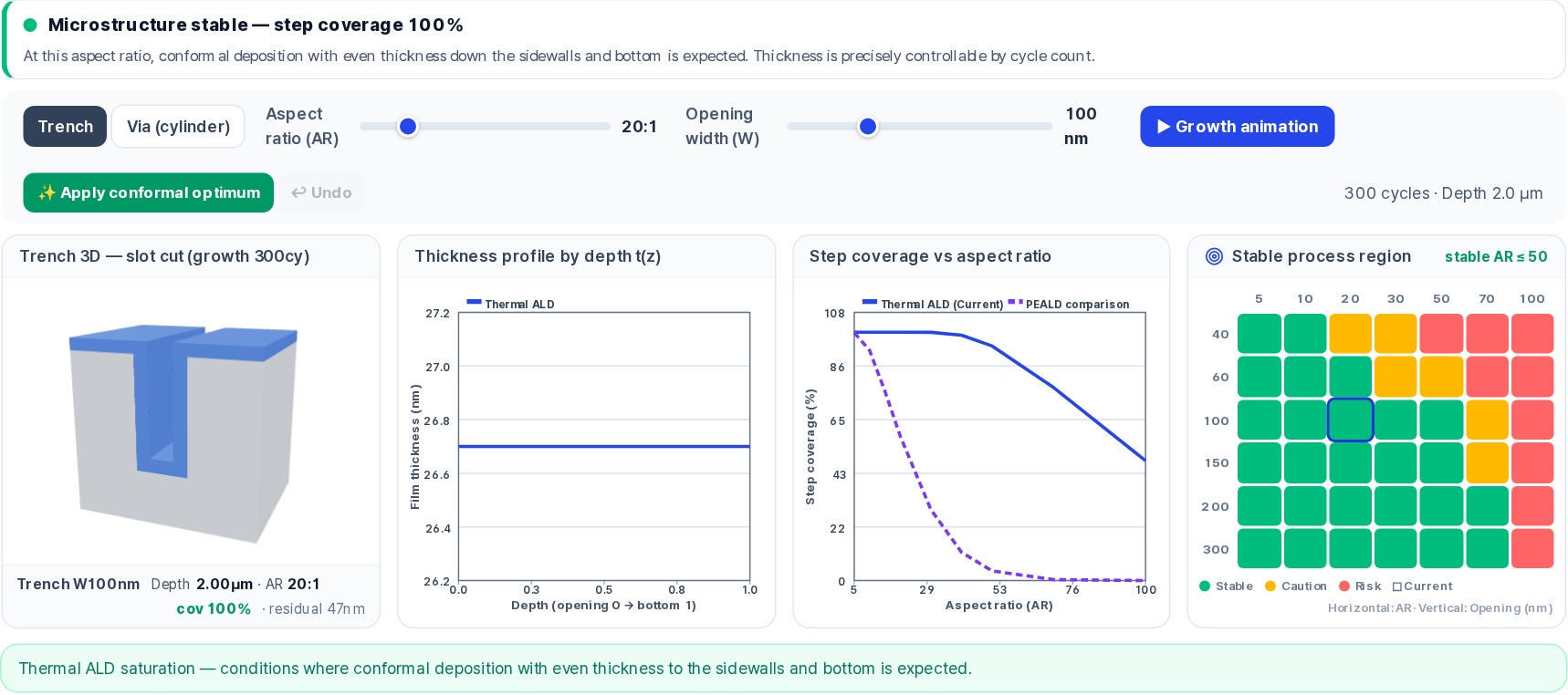
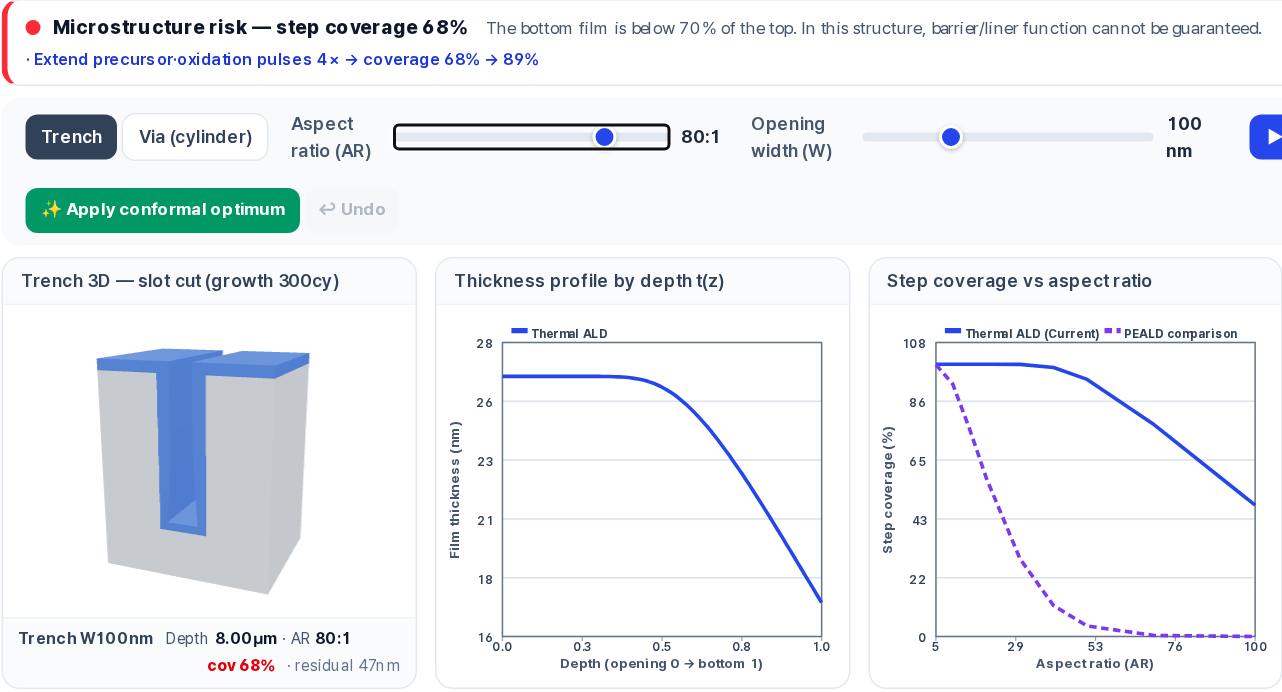
At 20:1 (100 nm opening), the predicted step coverage is 100% with a flat thickness profile. At 80:1 the prediction drops to 68%, and the tool suggests extending precursor and oxidation pulses 4× to bring coverage from 68% to 89%.
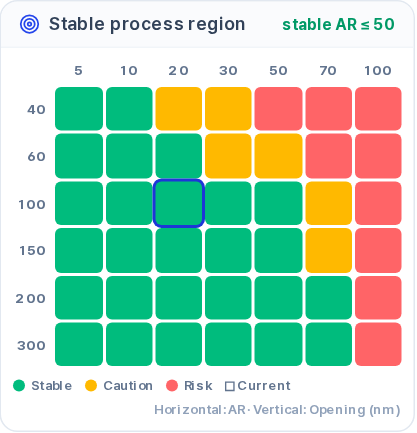
The stable region map marks aspect ratios up to 50 as stable for a 100 nm opening. Narrower openings shift toward caution or risk at lower aspect ratios.
FAQ
What is a good step coverage for ALD?
It depends on the film's function. A barrier or liner must be continuous at its thinnest point — the bottom of the feature — because a single break defeats the barrier. The acceptable percentage depends on the minimum thickness needed for that continuity.
Does longer purge improve step coverage?
Not directly, but insufficient purge degrades it. When reactants overlap in the gas phase near the opening, CVD-like growth creates an overhang that narrows the feature entrance and starves the bottom. Adequate purge prevents this.
Why is PEALD step coverage worse at high aspect ratio?
Plasma radicals recombine when they hit a surface. In a deep feature most radicals are lost on the upper sidewalls before reaching the bottom. Extending plasma time has diminishing returns because newly generated radicals face the same recombination path.
Is step coverage the same as conformality?
They overlap but are not identical. Step coverage is a specific ratio — typically bottom thickness divided by top thickness at a stated aspect ratio. Conformality describes how even the film is along the entire sidewall profile, which a single ratio does not fully capture.