
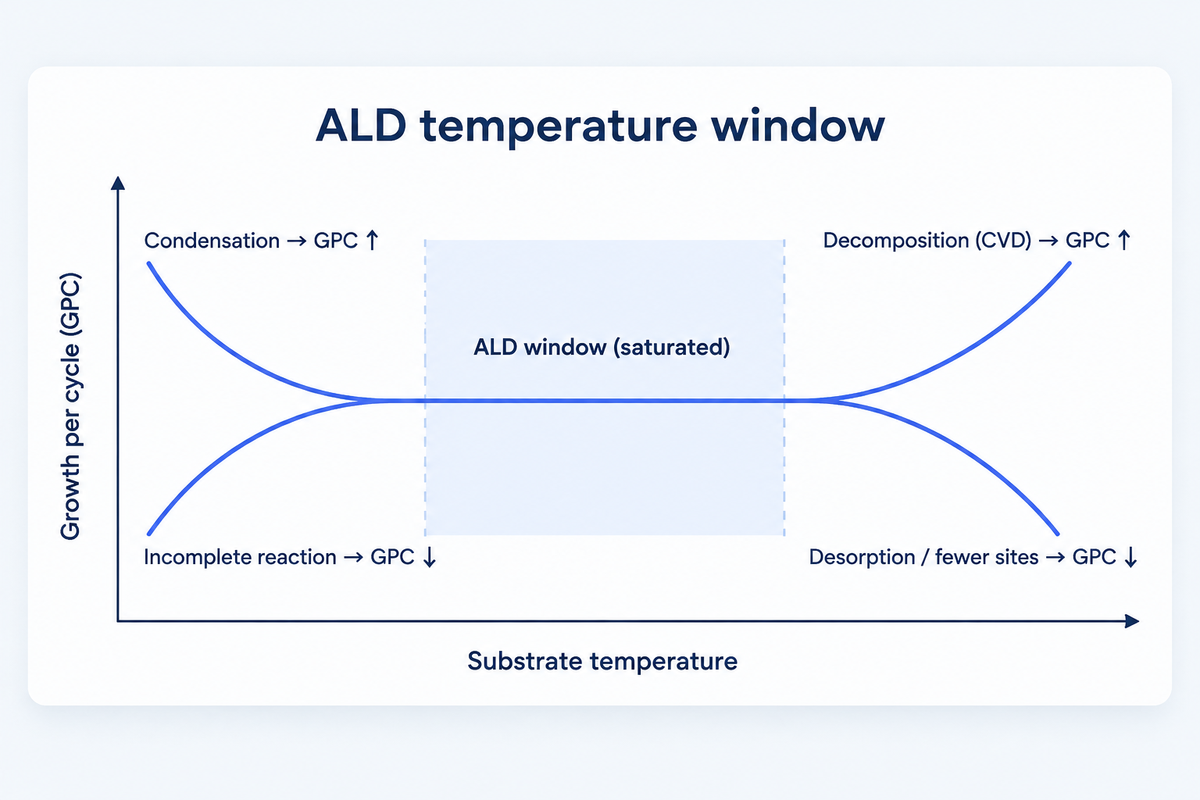
The ALD temperature window is the substrate-temperature range where both half-reactions are self-limiting — each precursor pulse saturates the surface and growth per cycle (GPC) depends on cycle count, not on dose or small temperature changes. Step outside this range and you lose the thickness control that makes ALD worth running. Understanding where the window sits, and what happens on either side, is fundamental to process design.
The window is defined by saturation, not a flat line
A common misconception: the ALD temperature window must show a perfectly constant GPC. It does not. Inside the window, GPC can drift slowly with temperature as the density of reactive surface groups (–OH, for instance) changes. The real test is that GPC is saturated — adding more precursor dose does not increase it — and roughly constant across a temperature span. If both conditions hold, you are inside the window.
GPC alone is not enough, either. Film density, refractive index, and impurity levels can shift even when GPC looks steady. Always cross-check these properties at each temperature point.
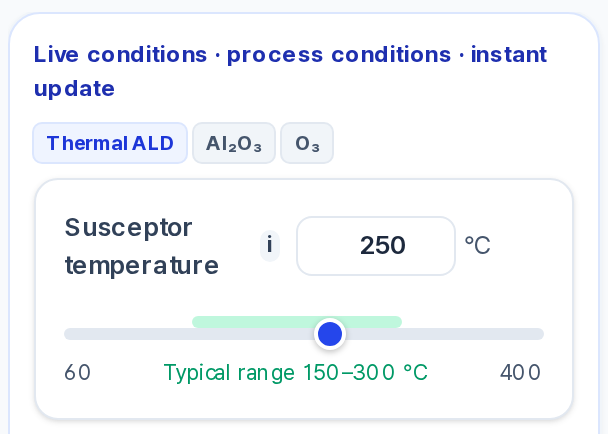
On our process screen the temperature slider marks a typical range for the chosen chemistry; for thermal ALD Al₂O₃ with TMA and O₃ it reads 150–300 °C. Treat that band as a starting point to check, not as a measured window for your tool.
Below the window: two opposite failures
Drop the substrate temperature below the window and one of two things happens.
GPC rises. The precursor or co-reactant condenses or physisorbs on the surface. Extra material is deposited each cycle, inflating the apparent GPC. The film suffers: higher impurity concentration, lower density.
GPC falls. The surface reaction lacks enough thermal energy to reach saturation before the pulse ends. Fewer sites react, so GPC drops. Again, film quality degrades.
Which case you see depends on the specific chemistry.
Above the window: two opposite failures
Raise the temperature past the upper boundary and, again, two outcomes are possible.
GPC rises. The precursor starts to decompose thermally, so it deposits without needing the other half-reaction. Growth becomes CVD-like: self-limiting behavior is lost, conformality degrades, and carbon or other impurities can be incorporated.
GPC falls. Desorption of the adsorbed precursor, or loss of reactive surface sites through dehydroxylation, leaves fewer sites available per cycle.
A higher GPC above the window is not a sign of a better process. It is a sign that ALD control has broken down.
One chemistry on our screen: TMA / O₃ Al₂O₃
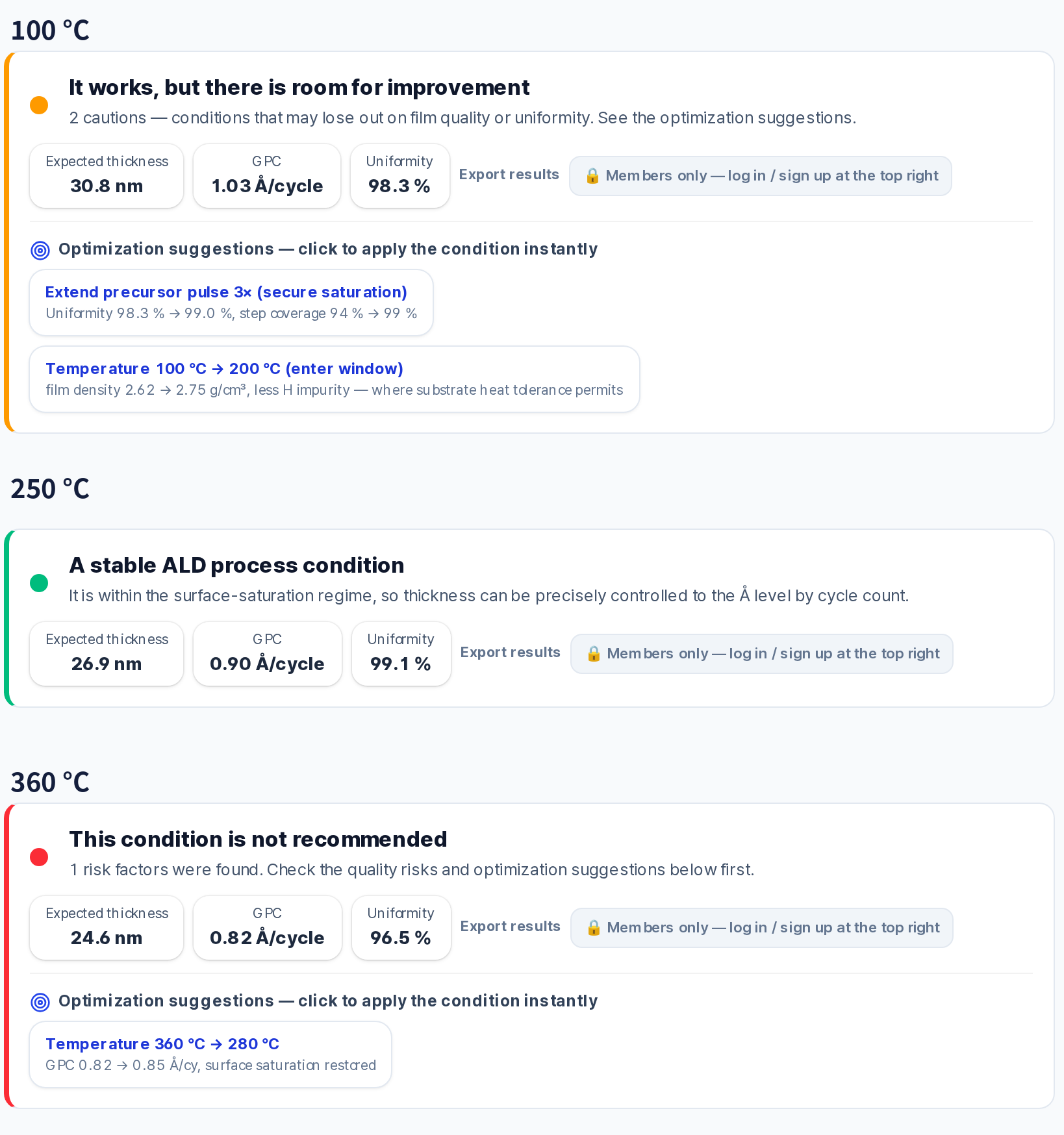
To make this concrete, here are model predictions for Al₂O₃ deposited with TMA and O₃ at 1 Torr, N₂ carrier at 200 sccm, 300 cycles. Only the susceptor temperature was changed.
100 °C — GPC 1.03 Å/cycle, uniformity 98.3 %, predicted density 2.62 g/cm³. The model flags room for improvement and suggests moving to 200 °C to enter the window, where density rises to 2.75 g/cm³ with less hydrogen impurity. It also recommends extending the precursor pulse 3× to secure saturation. This is the classic low-temperature "GPC up" case: more material per cycle, but a worse film.
250 °C — GPC 0.90 Å/cycle, uniformity 99.1 %. The model calls this a stable ALD process condition within the surface-saturation regime: thickness controllable to the ångström level by cycle count.
360 °C — GPC 0.82 Å/cycle, uniformity 96.5 %. The verdict: not recommended. Note that GPC at 320 °C is 0.78 Å/cycle — it fell above the window as dehydroxylation reduced available sites — then rose again at 360 °C as precursor decomposition added a CVD component. That uptick is not recovery. It is a different growth mode entirely.
How to measure your own ALD temperature window
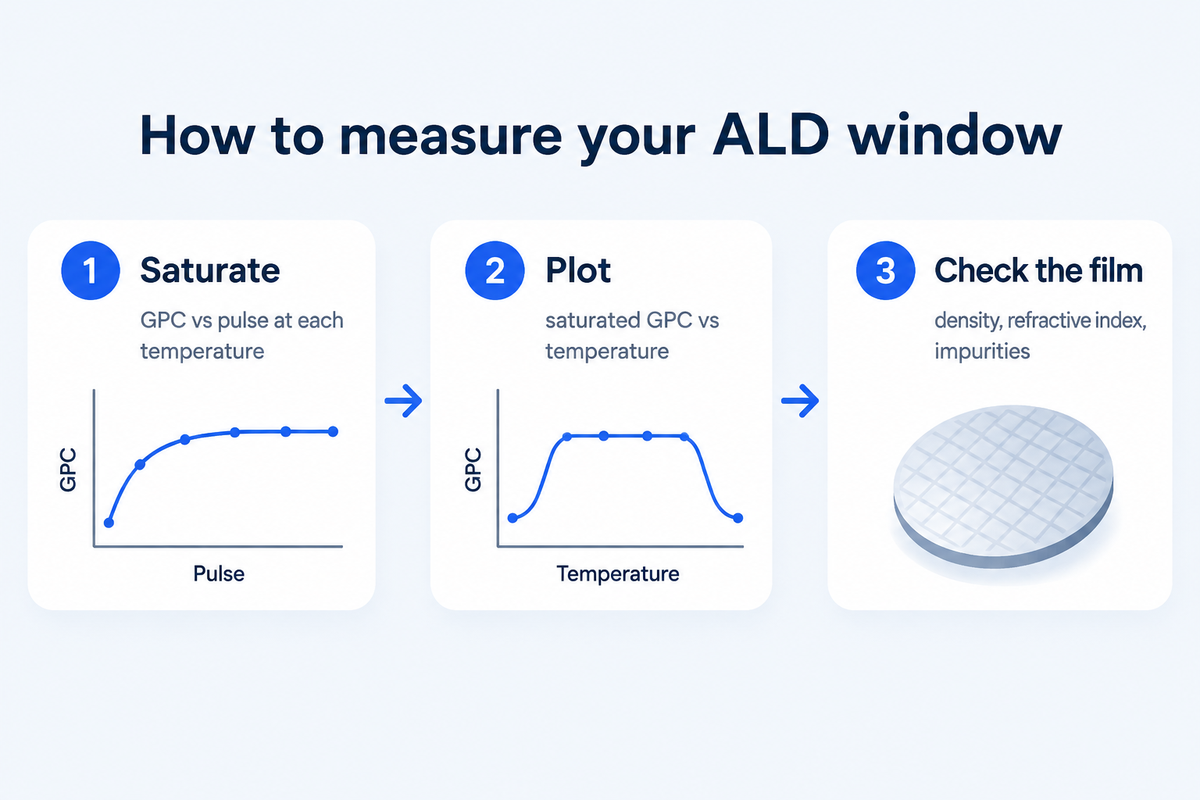
At each candidate temperature, first confirm saturation: plot GPC versus precursor pulse length and versus co-reactant pulse length, with purge times long enough to avoid overlap. Only then plot the saturated GPC versus temperature. The region where GPC is both saturated and nearly flat is your window.
A GPC-vs-temperature sweep run with unsaturated pulses draws a false window. Saturate first, then plot.
How to report an ALD temperature window
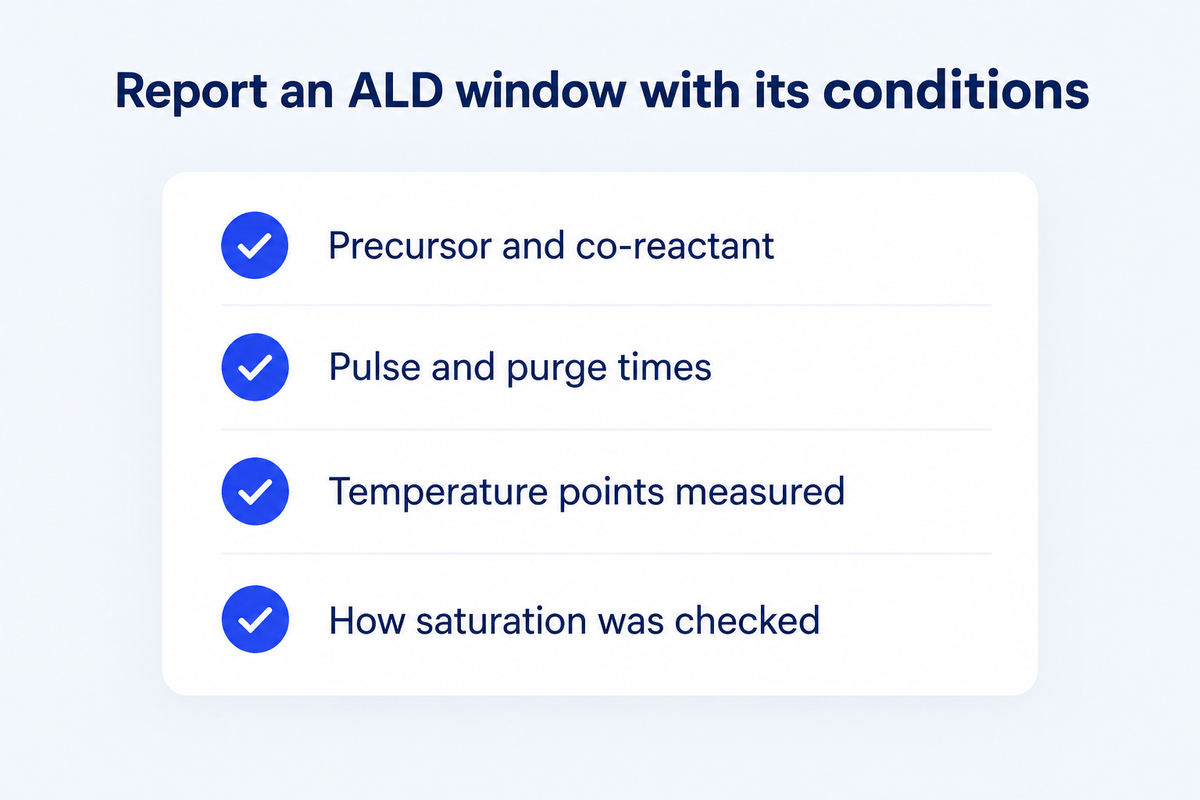
A window reported without context cannot be compared to anyone else's data. Always include: the precursor and co-reactant, pulse and purge times used, the temperature points tested, and how saturation was verified at each point.
Try it on your data: the free ALD GPC calculator finds the flat GPC band in your temperature series.
FAQ
What is the ALD temperature window?
The ALD temperature window is the substrate-temperature range in which both half-reactions are self-limiting. Inside this range, GPC is saturated and roughly constant, and film thickness is controlled by cycle count alone.
Why does GPC increase at low temperature?
Below the window, the precursor or co-reactant can condense or physisorb on the surface, depositing extra material each cycle. The resulting film typically has higher impurity content and lower density than film grown inside the window.
Why does GPC increase at high temperature?
Above the window, if the temperature exceeds the precursor's decomposition threshold, thermal breakdown adds a CVD-like growth component. Self-limiting behavior is lost, conformality degrades, and impurities such as carbon may be incorporated.
Is the ALD temperature window the same for every precursor?
No. The window is a property of the chemistry — the specific precursor and co-reactant pair. Changing either one shifts the window. A plasma co-reactant, for example, can lower the minimum temperature compared to a thermal process using the same precursor.
Semi Process Lab lets you explore the ALD temperature window before committing wafer time. Enter your precursor, co-reactant, and conditions; the model predicts GPC, density, uniformity, and flags when you are outside the window — with specific suggestions for getting back in. Try it at Semi Process Lab.