
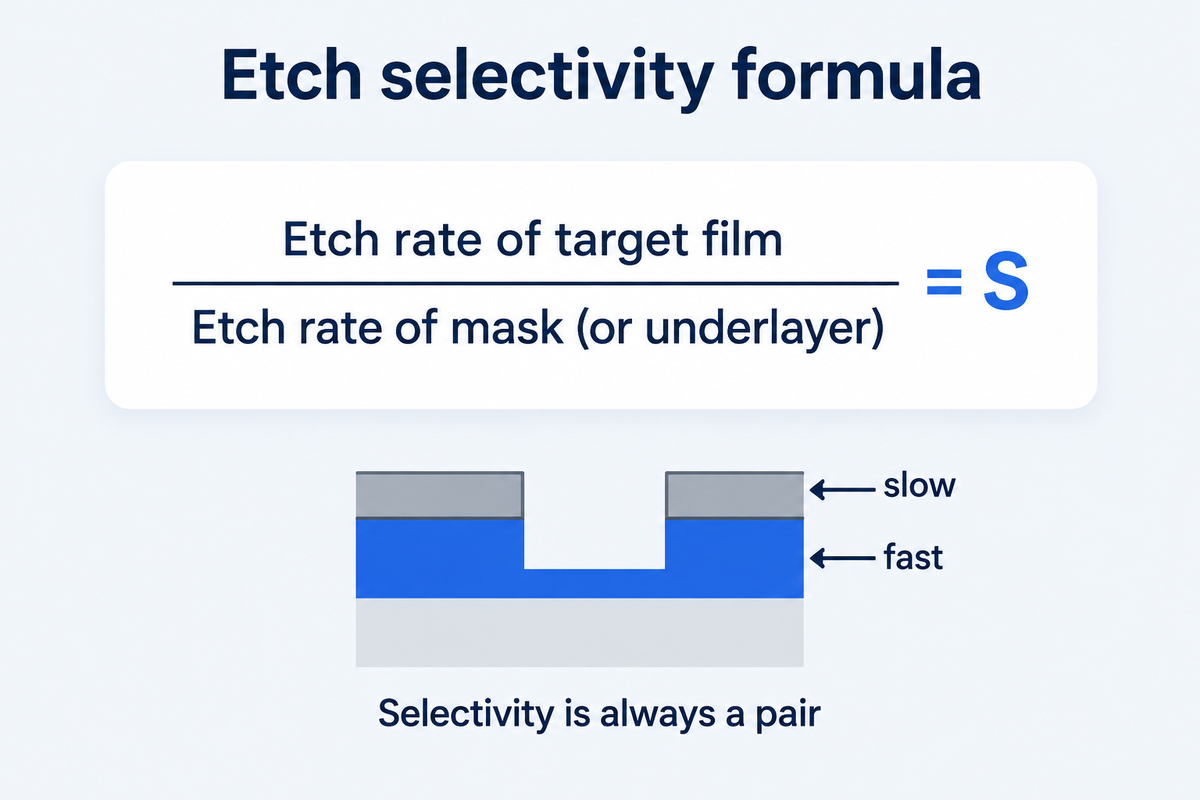
The etch selectivity formula is a ratio of two etch rates: S(A : B) = ER_A ÷ ER_B, where A is the film you want to remove and B is the film you want to keep. Selectivity is always a pair — stating a single number without naming both films is incomplete. Two pairs matter in practice: target-to-mask (will the mask survive?) and target-to-underlayer (will the etch stop cleanly?).
Two formulas, not one
Formula 1 — rate ratio. Measure the etch rate of the target film and the etch rate of the mask on separate blanket wafers under the same plasma. Divide:
S_rate = ER_target / ER_mask
This is the number most often quoted. It is measured at a single moment, on unpatterned films.
Formula 2 — consumption ratio. Measure what actually happened on the patterned wafer after the etch is done:
S_consumed = (depth etched in the target) / (mask thickness consumed)
This is the number that decides whether your mask survives. It folds in everything the rate ratio ignores: over-etch time, aspect-ratio-dependent etch (ARDE), and mask faceting.
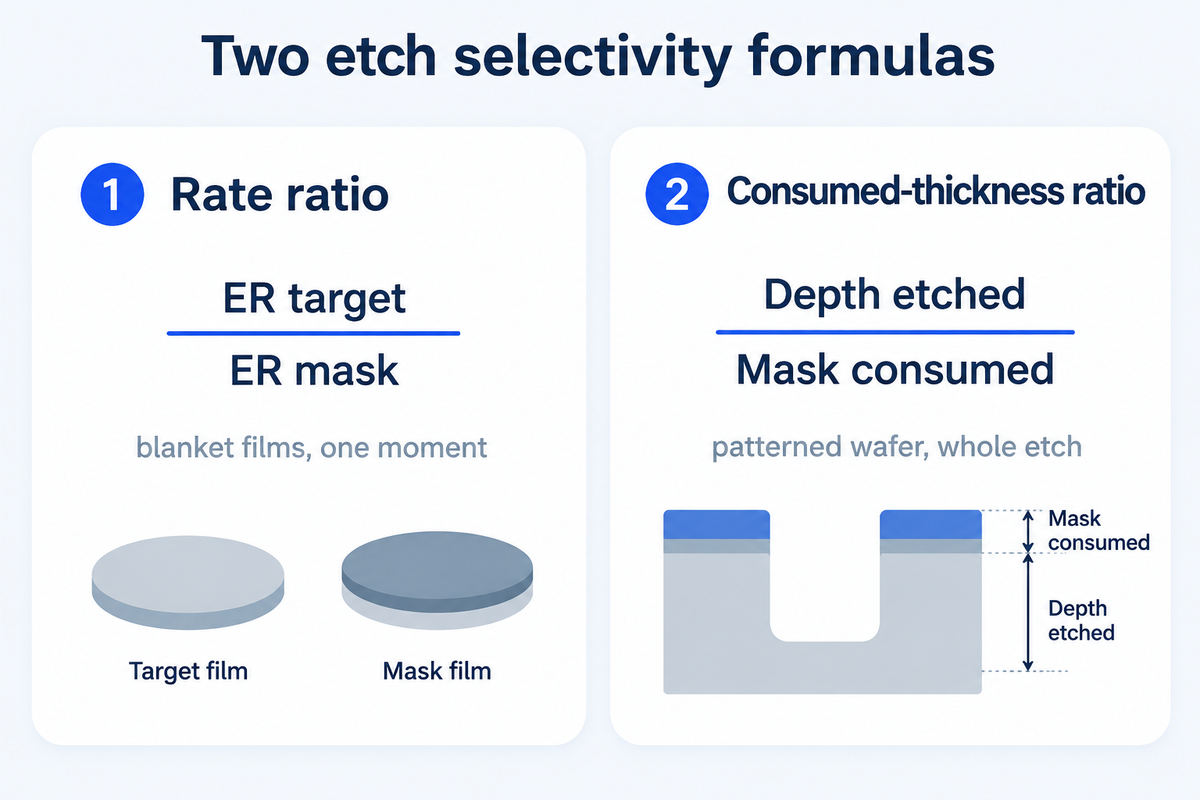
The two formulas agree only when both rates stay constant and the etch time is identical for both films. In practice, they rarely do.
Why the two formulas diverge
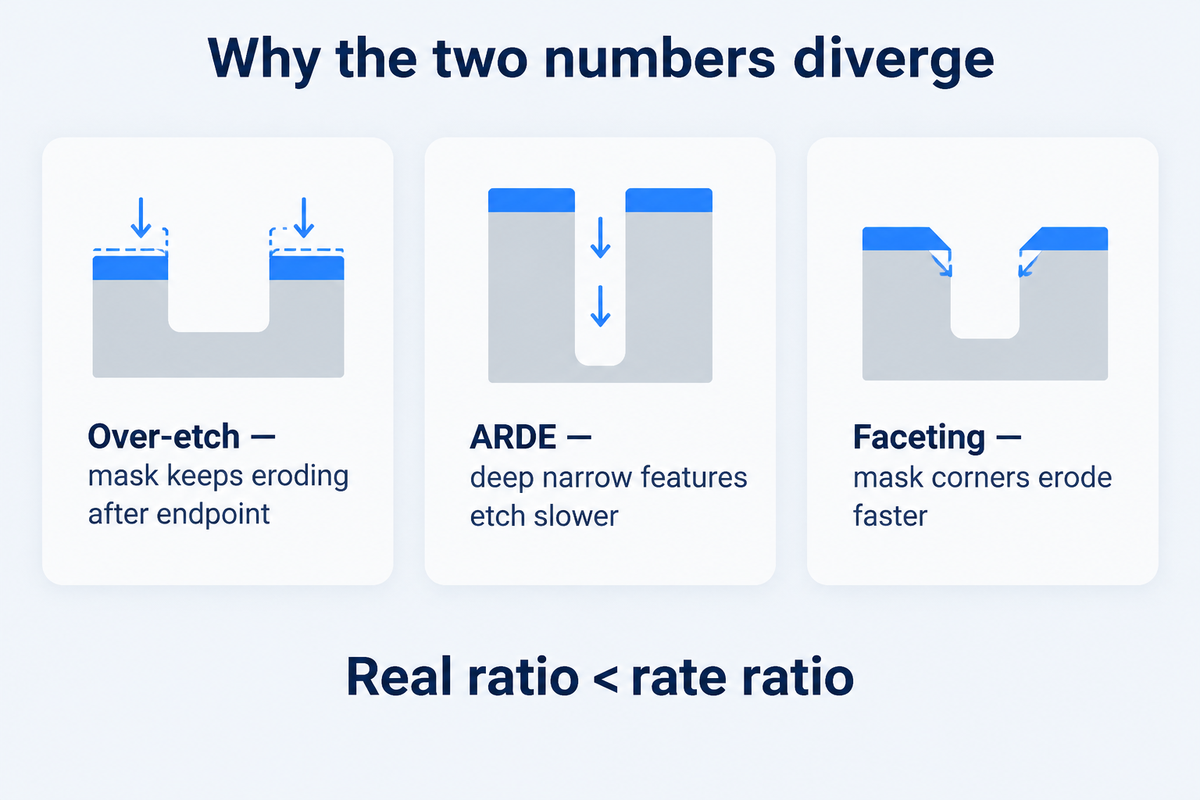
Three mechanisms pull the consumption ratio below the rate ratio.
Over-etch. After the target film reaches endpoint, the target depth stops increasing — but the mask keeps eroding. Every second of over-etch lowers the consumption ratio while leaving the rate ratio untouched.
ARDE. In deep, narrow features the target etch rate drops with depth. The mask top, exposed to the full plasma, erodes at its normal rate. The deeper the feature, the wider the gap between the two formulas.
Mask faceting. Ion bombardment rounds the mask corners, thinning the mask faster than a blanket-film measurement would predict. As the mask thins, its removal rate can change further.
Mask budget
A quick mask-thickness estimate uses only the rate-ratio selectivity:
mask needed ≥ target depth × (1 + over-etch fraction) / S_rate + margin
This under-sizes the mask whenever ARDE or faceting is significant — which is most of the time in high-aspect-ratio etches. The consumption ratio is a safer basis for the budget, but it requires running (or predicting) the full etch on a patterned structure.
What "high selectivity" means — and the knobs
When dry etch selectivity is high, the target etches much faster than the other film. A thinner mask can survive the full etch, and the underlayer loses little thickness at endpoint. High selectivity alone does not guarantee a good profile; bowing, tilting, and undercut are separate problems.
General directions for tuning etch rate selectivity:
- Higher ion energy (bias power) adds physical sputtering that removes mask and target at closer rates. Selectivity tends to fall.
- More chemical etching — radical-driven or polymerizing chemistries, sidewall passivation — widens the rate difference. Selectivity tends to rise.
- Harder mask materials (hard masks instead of photoresist) raise the target-to-mask selectivity ratio directly.
How to report selectivity
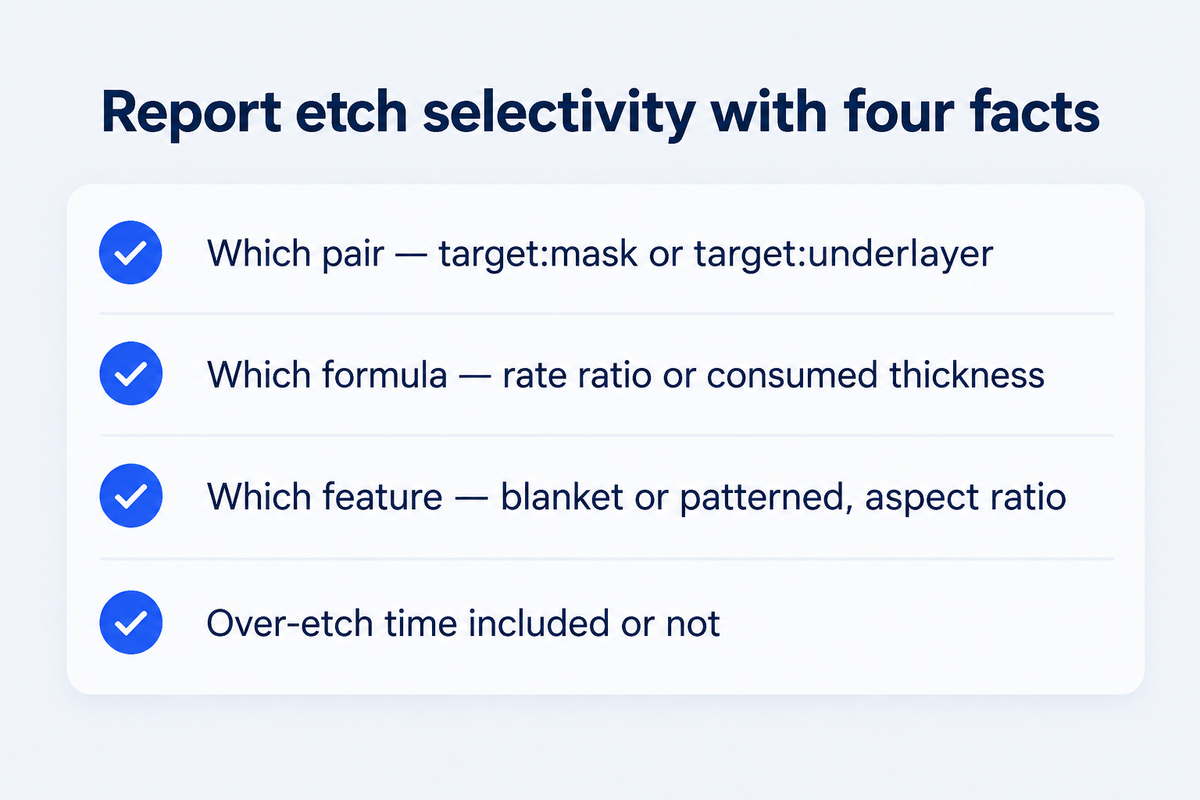
A bare selectivity number cannot be compared across papers, specs, or tools. State four things:
- Which pair — target : mask or target : underlayer.
- Which formula — rate ratio (blanket) or consumption ratio (patterned).
- Which feature — blanket film, patterned feature, and if patterned, the aspect ratio.
- Over-etch — included or not.
One trench, one number
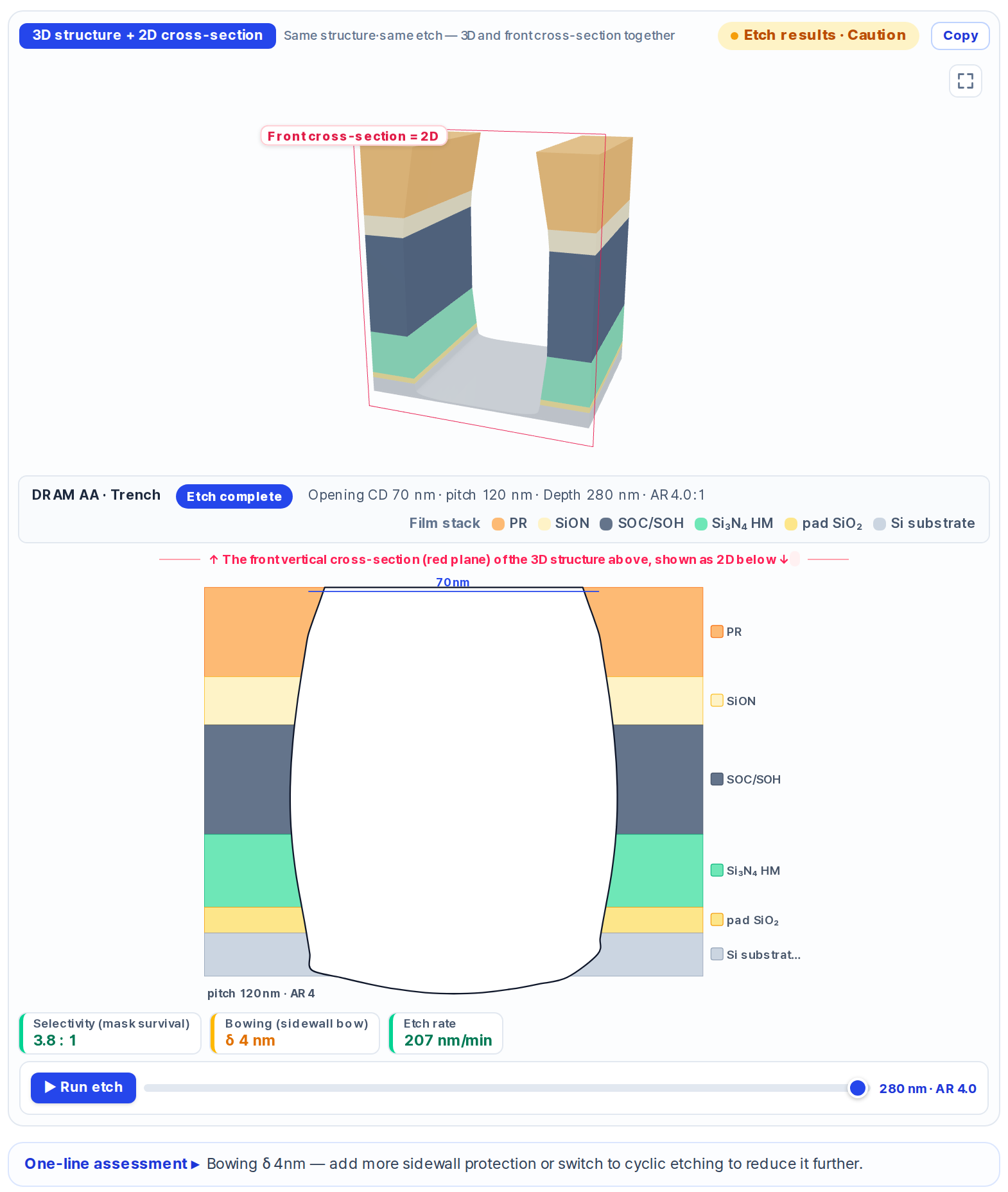
On a patterned stack, the consumed-thickness ratio is the number to watch. The screen below shows a DRAM AA trench with a 70 nm opening, 280 nm depth and AR 4.0 : 1. Selectivity here is etched depth divided by mask consumed, with over-etch time and the depth lost to ARDE already included. The model predicts 3.8 : 1, a bowing δ of 4 nm and an etch rate of 207 nm/min. These are model predictions, not wafer measurements.
Try it on your data: the free etch selectivity calculator puts both ratios and the mask budget side by side.
FAQ
What is the etch selectivity formula?
S = etch rate of the target film ÷ etch rate of the reference film (mask or underlayer). On patterned wafers, the consumption-ratio form — etched depth ÷ mask thickness consumed — is more representative because it captures over-etch and ARDE effects.
When etch selectivity is high, what does it mean?
It means the target film is removed much faster than the film you want to protect. You can use a thinner mask, or stop on the underlayer with minimal loss. It does not, by itself, mean the etch profile is acceptable.
Is selectivity the same as etch rate ratio?
The rate ratio is one way to express selectivity, but not the only way. The consumption ratio — measured after a real or predicted patterned etch — is often lower because over-etch, ARDE, and faceting erode the mask beyond what the blanket rate predicts.
What selectivity do I need for my mask?
At minimum: target depth × (1 + over-etch fraction) ÷ available mask thickness. In practice, add margin for ARDE and faceting. For high-aspect-ratio features, estimate the consumption ratio rather than relying on the blanket rate ratio.
Semi Process Lab's Stacked-structure Etching screen reports selectivity as etched depth ÷ mask consumed, over-etch included, and flags a mask that is etched through before the target depth is reached. The values are model predictions meant to compare mask and bias choices before you commit wafers; confirm the chosen condition on your own patterned wafers. Try it at Semi Process Lab.