
Process targets for semiconductor and display development usually start life in somebody else's paper — a thickness, a mobility, an etch selectivity, copied into a recipe. Most of what goes wrong afterwards traces back to one thing: the number arrived without the conditions that produced it.
The number you copied, without its conditions
A single property usually carries more than one reported value in a paper — and a short summary of that paper will rarely tell you so.
We measured this on our own records. Our summary cards are built by reading the front of a paper and keeping at most a handful of reported values — the same shortcut most people take. We then re-read the full text of a batch of papers we had already carded, which gave 67 (paper, property) pairs. 64 of the 67 (96%) turned out to carry more than one reported value. Our own cards had shown that for about 22%. The gap is what the shortcut costs.
So the number you copied is almost certainly one survivor from a set — and the abstract kept the most publishable one, not the one nearest your process window.
What re-reading the full text turned up
Six ways a value loses its meaning between the paper and your recipe:
- Range endpoints taken as values. "2.0 to 5.3 nm" recorded as 2.0 nm. "23–40 nm" recorded as 23 nm.
- Figure axis ticks read as data. A y-axis maximum of 0.3 A entered as a measured drain current.
- Property names confused. A coupling efficiency filed under power conversion efficiency.
- Computed values filed as experimental data. Results from modeling-only work sitting in the same table as measurements, with nothing to tell them apart.
- Rounding that erases conditions. Two results, 80.5 and 80.2, collapsed into one entry — and the conditions attached to the second one disappeared with it.
- Decimal commas misread. "78,94" means 78.94. Read without that convention in mind, the value either vanishes or splits into 78 and 94.
Wrong conditions are worse than missing conditions, because you trust them.
Conditions are inputs, not footnotes
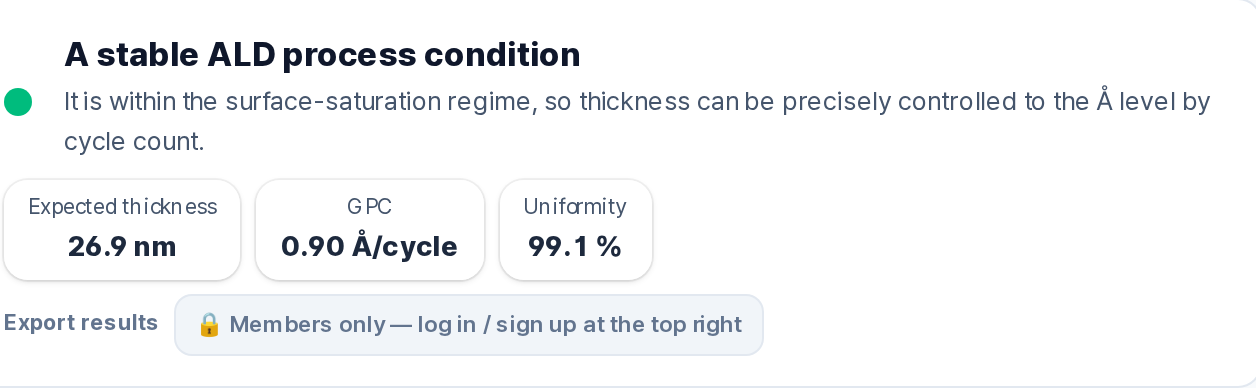
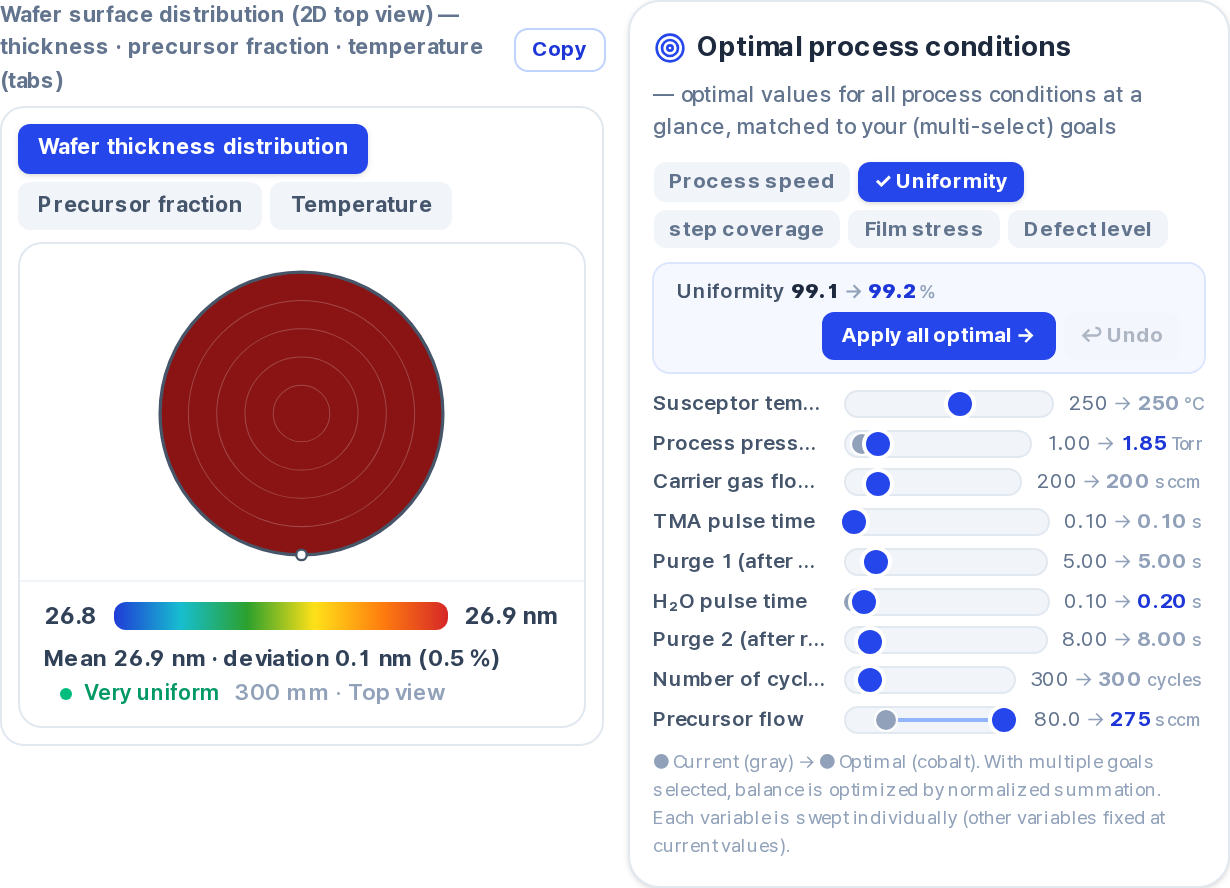
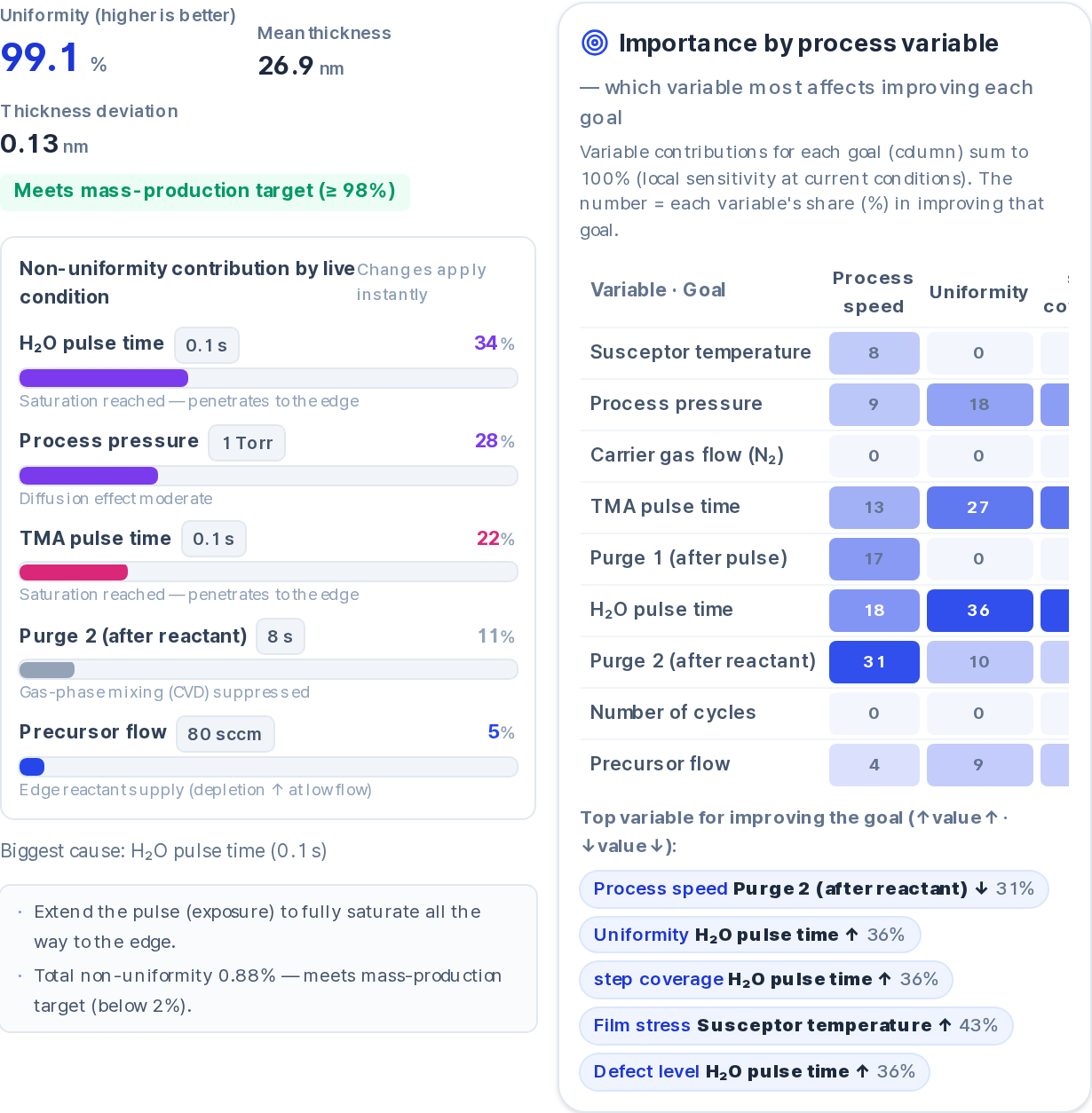
The alternative to copying a number is stating the conditions yourself and predicting the outcome under them.
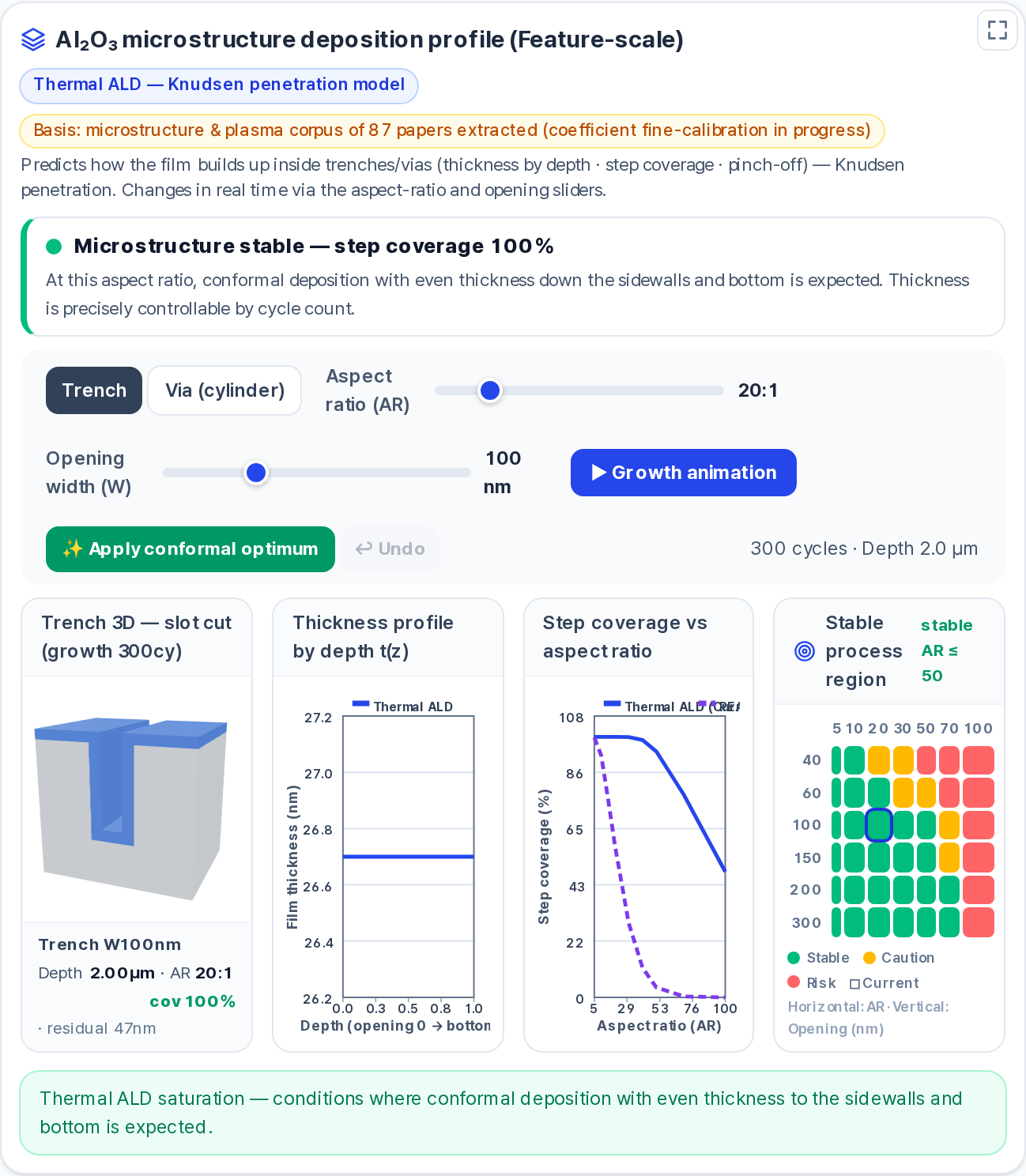
The rule we apply to reference values
When Semi Process Lab shows a value taken from published work, the conditions travel with it — as the wording the paper itself used, not as a form we filled in. A condition might read "E-SnO2" or "Scherrer method". It is short, and it says only as much as the source said.
Where a paper reports several values for the same quantity and the source does not let us say which one a given number refers to, we do not show it. That is where the 283 withheld values come from.
FAQ
Why do abstract values so often fail to reproduce in the fab? An abstract reports one representative value chosen from many, produced under conditions it rarely states in full. Applied under different conditions, the mismatch is expected — not an anomaly, and not your chamber.
What should I do when a paper reports only one value for a property? Treat it as one survivor rather than the whole result. In our own check — a batch of papers re-read in full, giving 67 (paper, property) pairs — 64 pairs carried more than one value, while our own summary cards of the same papers had shown that for about 22%.
Is it safe to use values from summary tables in review articles? Use them as an index, not as evidence. Range endpoints become single numbers, rounding merges neighbouring results, and the conditions column is often incomplete. Go back to each original source before setting a target.
Why withhold a value instead of showing it? Because showing the wrong one is worse than showing none. A value attached to conditions it may not belong to reads as fact; a missing value at least asks to be looked up.