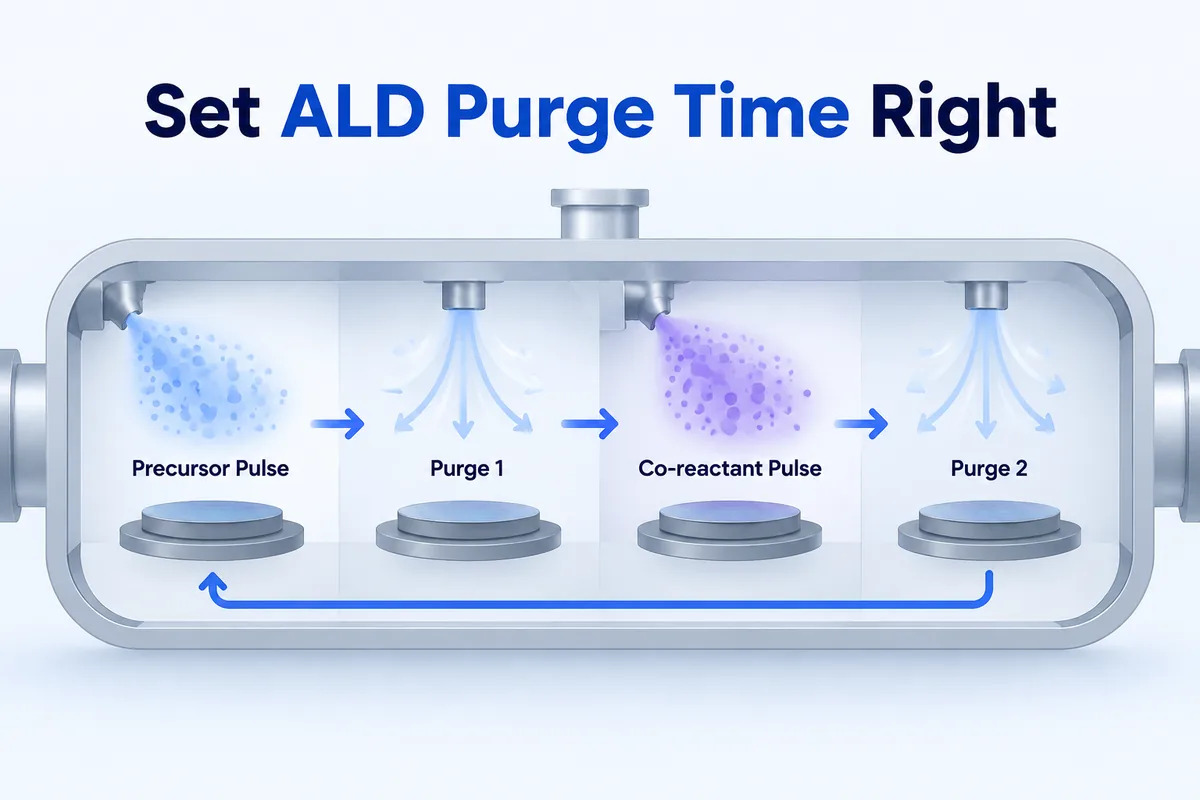
Every ALD cycle has four steps: precursor pulse, purge, co-reactant pulse, purge. The two purge steps flush unreacted precursor and reaction by-products out of the chamber with inert gas—N₂ or Ar—so the two reactants never meet in the gas phase. The practical question is not whether a longer purge is safer but where the film stops changing when you extend it.
What a short purge does
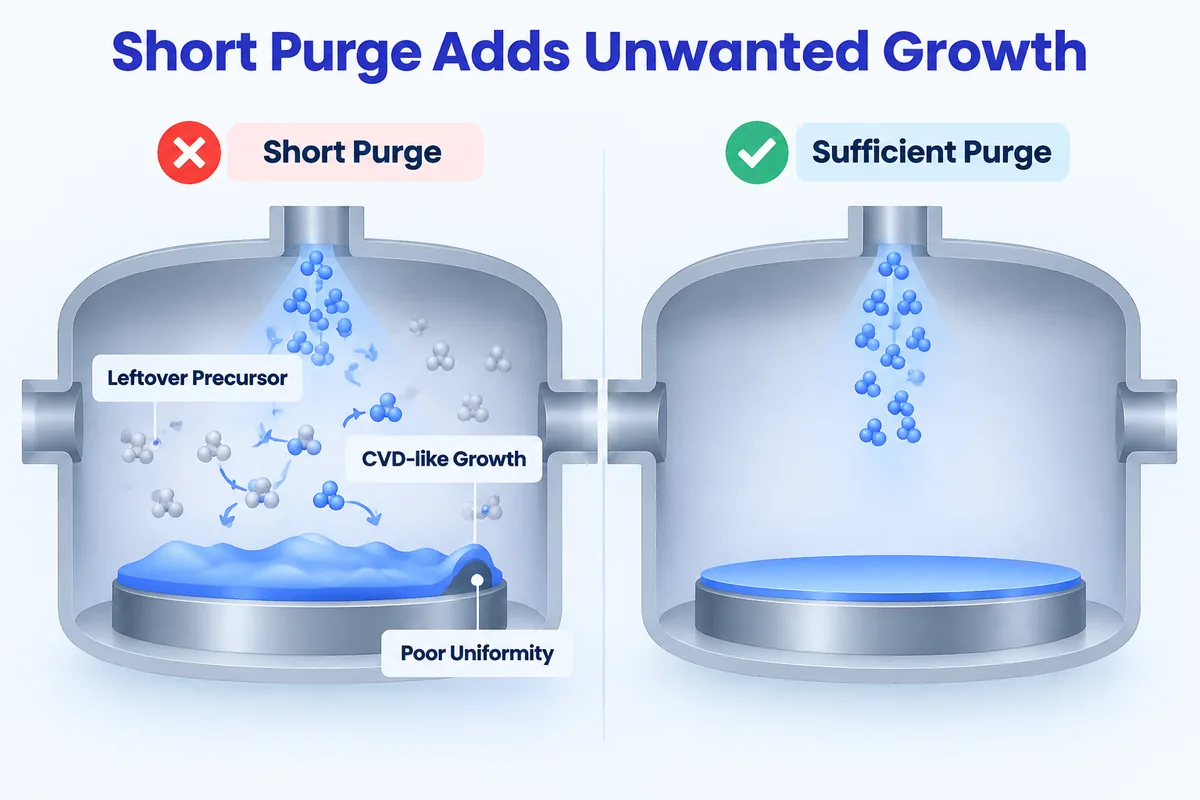
Cut the purge too short and leftover precursor is still in the chamber when the co-reactant arrives. The two gases react in the vapor, adding a CVD-like component on top of the self-limited surface reaction. Growth per cycle rises above the expected value.
Uniformity suffers as well. The extra growth tends to concentrate where gas lingers—near the inlet, in dead volumes, or at the wafer edge—depending on chamber geometry. Particles and impurities can follow.
Find the plateau, then add margin
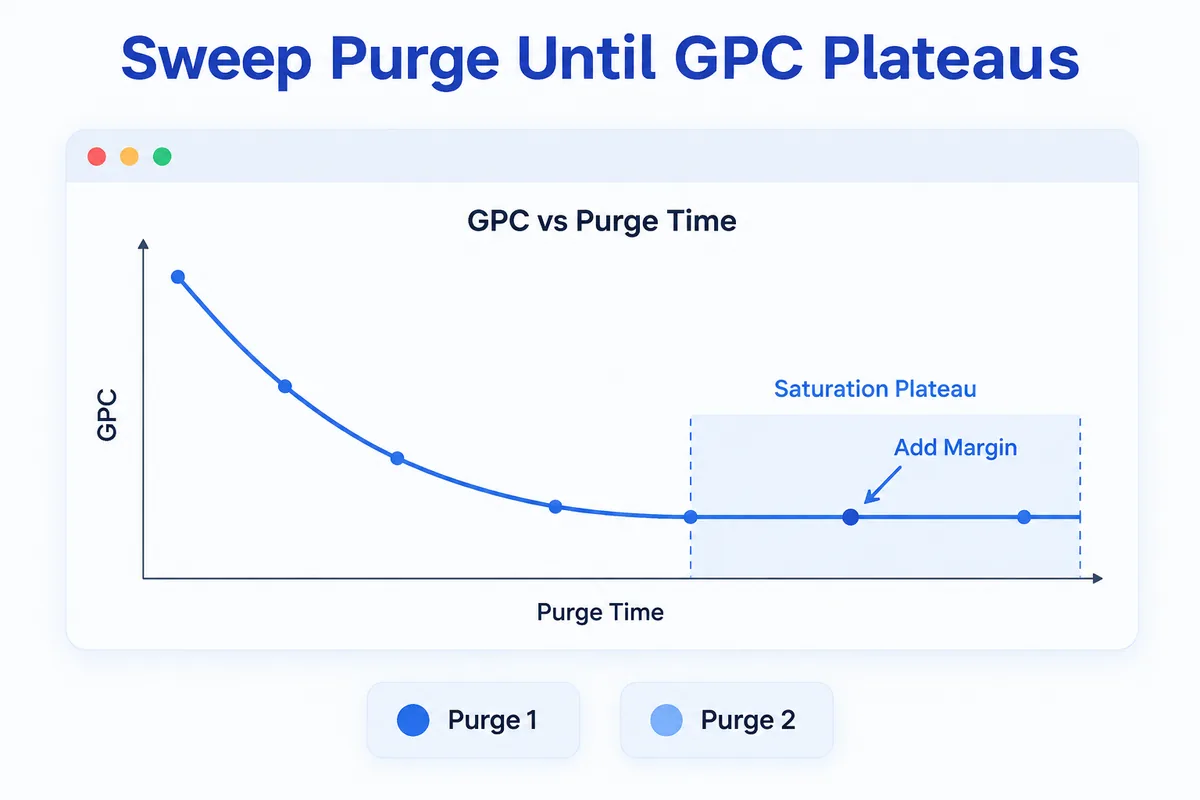
The standard method is a purge saturation test. Fix pulse times, temperature, and pressure. Then step the purge time up while measuring GPC and uniformity after each run.
At short purge times, GPC will be elevated. At some point it levels off into a plateau—the purge is now sufficient for self-limited growth. Pick a value on that plateau and add a reasonable margin so small day-to-day drift does not push you back into the parasitic regime.
Run this test separately for the purge after the precursor (purge 1) and the purge after the co-reactant (purge 2). They serve different reactants with different vapor pressures and sticking behaviors, so there is no reason to expect them to need the same time.
Why the same purge does not transfer between tools
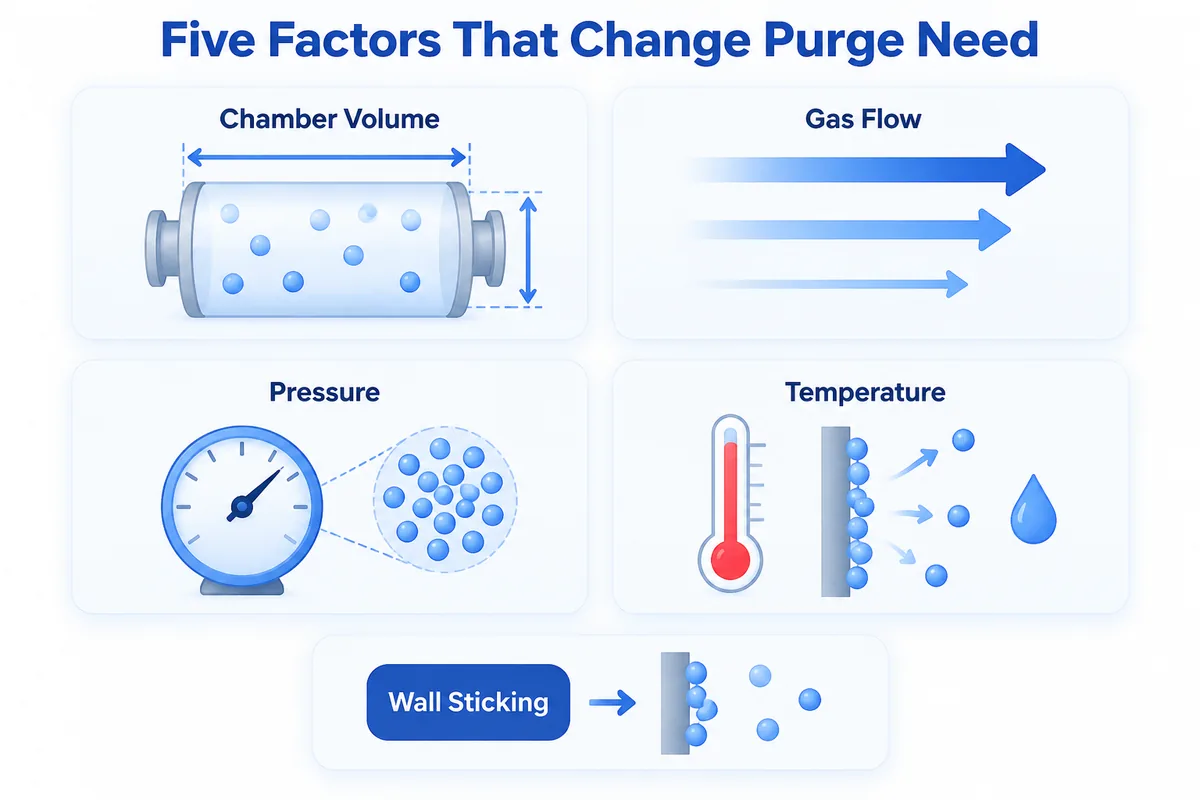
A purge time validated on one chamber is a starting point on another, not an answer. Several factors set how quickly a reactant clears.
Chamber volume and geometry determine the gas residence time. A larger chamber or one with recessed pockets needs more time for the same flow rate. Carrier and purge gas flow directly affect how fast fresh gas displaces the old. Process pressure matters because higher pressure slows diffusion and can trap molecules in low-flow regions.
Temperature changes how quickly reactants desorb from the chamber walls. Reactants that adsorb strongly on chamber surfaces are the hardest to purge. Water at low temperature is a commonly cited example: it adsorbs strongly on the walls and is slow to clear.
When you move a process to a new tool, re-run the purge saturation test. For more on why recipes do not copy directly, see chamber-to-chamber variation.
Write both purge times next to the result
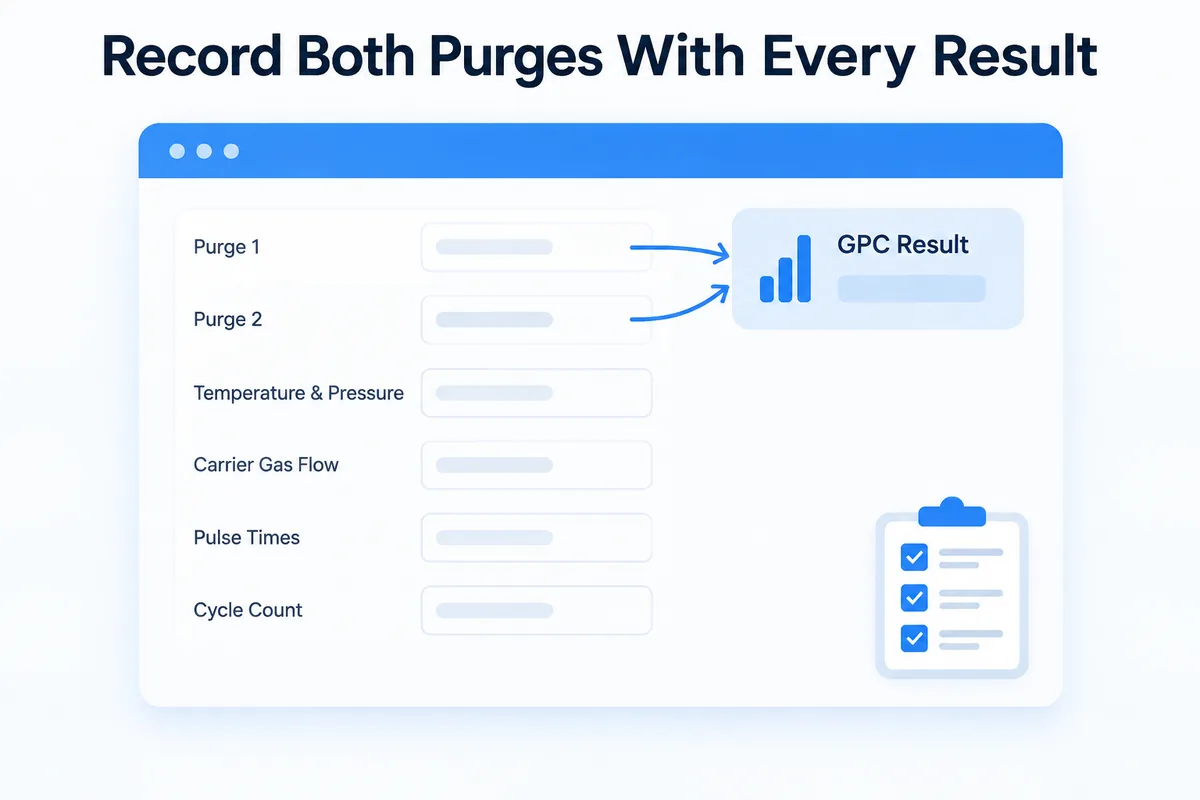
A GPC or uniformity number reported without its process conditions cannot be compared to anything. Every result should carry both purge times—purge 1 (after the precursor) and purge 2 (after the co-reactant)—alongside temperature, pressure, carrier gas flow, pulse times, and cycle count.
This is not extra paperwork. It is the minimum needed for someone else (or your future self) to reproduce or interpret the data. If a colleague's GPC is higher than yours, the first thing to check is whether the purge was shorter. For more on why bare numbers mislead, see a number without its conditions.
FAQ
How long should an ALD purge be?
There is no single number. The required purge time depends on the reactant, the chamber, and the process conditions. Run a purge saturation test—step the purge time up and find where GPC stops changing. That plateau is your answer.
What happens if the purge is too short?
Leftover reactant meets the next pulse in the gas phase, producing a CVD-like growth component. GPC rises above the self-limited value, uniformity degrades, and particles or impurities may appear.
Should purge 1 and purge 2 be the same?
Not necessarily. Purge 1 clears the precursor; purge 2 clears the co-reactant. They may have very different vapor pressures and wall-sticking behavior, so test each independently.
Does a longer purge improve film quality?
Only up to the point where the parasitic CVD component disappears. Beyond that plateau, extending the purge adds cycle time without improving the film.
How Semi Process Lab keeps purge times with the result
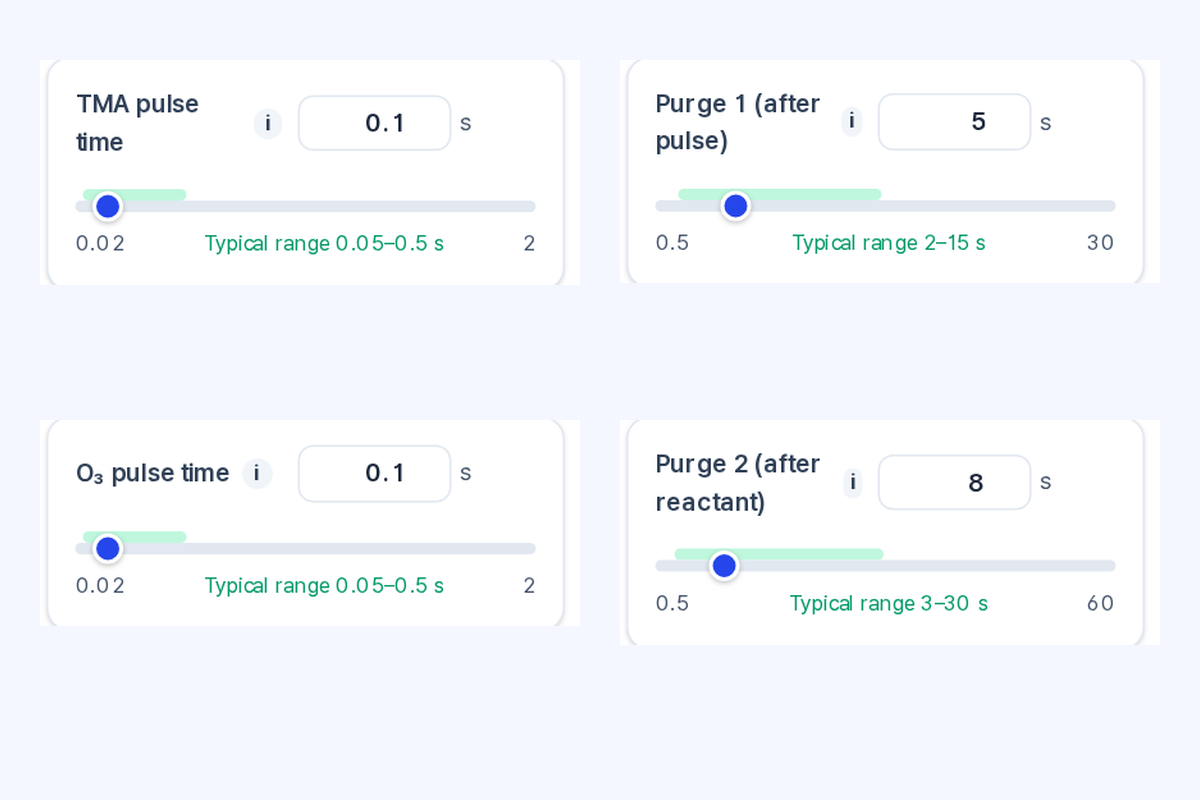
On the Semi Process Lab process design screen, Purge 1 (after pulse) and Purge 2 (after reactant) sit right next to susceptor temperature, process pressure, carrier gas flow, pulse times, and cycle count. Each parameter has a typical-range band—the screen's example for thermal ALD Al₂O₃ with O₃ shows 2–15 s for Purge 1 and 3–30 s for Purge 2. Logged-in users can save the full condition set and reload it later. Results are model predictions meant to narrow the experimental search before you commit wafers.